
Internal bifold doors in Newcastle, supplied and fitted
Room dividers for kitchen-diners, compact bifolds for cupboards and utilities, and glazed or solid panels in oak, white or grey. We measure, supply and fit across Newcastle and the North East.
- Room dividers
- Cupboard & utility bifolds
- Glazed or solid panels
Internal bifold doors for Newcastle homes
Most people looking at internal bifold doors in Newcastle have one of two problems. Either a hinged door swings into a space that is too tight for it, or an open-plan room needs a way to close off when cooking smells drift through or someone wants the telly loud. A bifold folds back on itself, so it needs only a fraction of the floor space a swinging door takes up.
We supply and fit everything from two-leaf bifolds for cupboards and utilities to multi-panel room dividers between kitchens, dining rooms and lounges. Much of our work is in terraces and semis across Newcastle, Gateshead and North Tyneside, where every bit of floor space counts.
If you are still deciding on a look, our door styles guide shows the panel designs that are made in bifold form.
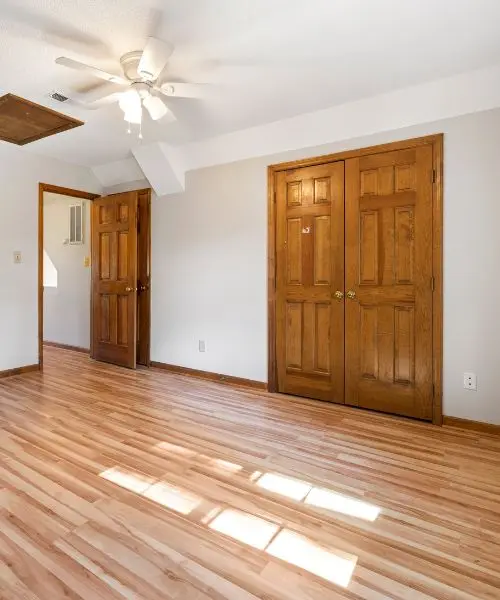
Where do internal bifolds work best?
Room dividers
Between a kitchen and dining room, or a lounge and a conservatory, a three, four or five-panel bifold lets you open the whole wall in summer and close it again in winter. Most room dividers include a single traffic door that opens on its own, so you don't have to fold the whole run every time you walk through.
Cupboards, utilities and wardrobes
This is where a bifold really earns its keep. A two-leaf bifold on a boiler cupboard or under-stairs store opens to give full access to the space, but only projects about half the door's width into the hallway. Utility cupboards with a washer and dryer behind them are a common job for us, as are alcove wardrobes in bedrooms.
Awkward hallways and landings
Where a door clashes with a radiator, a stair newel or another door, a bifold is often a cheaper fix than moving the opening. We'll tell you honestly if a sliding or pocket door would suit the spot better.
How bifold track systems work
Most internal bifolds are top-hung. The weight of the doors sits on rollers in an aluminium track fixed to the head of the opening, and a pivot at the bottom of the first leaf keeps everything in line. There is no raised track on the floor to trip over.
The head of the opening makes or breaks a bifold. The track has to be level and fixed into solid timber, because any sag shows up as panels that rub, drop or won't close flush. In older Newcastle houses we often find heads that are a few millimetres out over a metre, so we pack and shim the track before the doors go on.
- Top rollers carry the weight, so the floor only needs a small pivot or guide
- Tracks can be adjusted after fitting to take out small drops
- Magnetic or ball catches hold the panels closed
What sizes do internal bifold doors come in?
Internal bifold kits are made to set sizes based on standard UK door heights. Most are 1981 mm (6'6") or 2040 mm tall and 35 mm thick, with each leaf matching a common door width. The overall width depends on how many panels you choose.
| Panels | Typical use | Notes |
|---|---|---|
| 2 | Cupboards, utilities, wardrobes | Often fits an existing single door opening with small lining changes |
| 3 | Wide cupboards, smaller room dividers | Folds to one side or splits two and one |
| 4 | Kitchen-diner dividers | Splits two and two, or folds to one side with a traffic door |
| 5 to 6 | Full-width room dividers | Needs a strong, level head and accurate setting out |
Because kits come in fixed widths, the opening rarely matches exactly. We usually adjust it with new linings and architrave to suit the kit, which gives a cleaner result than cutting down the panels. For a rough idea before you get in touch, our guide on how to measure an internal door explains what to note down.
Glazed or solid bifold doors?
Glazed bifolds keep daylight moving through the house. That matters in north-facing kitchens and long terraces where the back room can feel dark. Clear glass lets through the most light, while obscure or reeded glass softens the view and hides clutter. The kits we fit come with safety glass already installed.
Solid bifolds are better for cupboards, utilities and anywhere you want to hide what's behind them. They also cut noise a little more than glass, though no bifold seals as tightly as a hinged door. For a consistent look, choose the same range as your other doors, whether that's oak, white primed for painting, or grey.
Tip: if you are replacing every door in the house, choose the bifold at the same time. The panel lines and finish will then match exactly, which is hard to achieve later.
Bifold vs sliding doors: pros and cons
| Bifold | Sliding | |
|---|---|---|
| Space needed | Panels stack in or just beyond the opening | Needs clear wall beside the opening, or a pocket inside the wall |
| Opening width | Opens almost the full width | A pair of sliders only opens half the width |
| Wall changes | None | Wall must be free of switches, sockets and radiators where the door runs |
| Privacy | Small gaps at the folds | Gaps at the edges, though pocket doors close more snugly |
| Best for | Room dividers, cupboards | En-suites, narrow rooms, barn-style looks |
As a rule, choose a bifold when you want to open up a wide space, and a slider when the wall beside the opening is clear and you'd rather the door was out of the way altogether.
Bifold door questions we're often asked
Can a bifold door replace a normal door?
Yes, in many openings. A two-leaf bifold often fits a standard single door opening, although the lining usually needs adjusting to suit the kit width. We measure first and include any lining work in the quote.
Will I need to change my flooring?
Usually not. Most internal bifolds are top-hung with a small pivot at the bottom, so there is no raised track on the floor. Carpet, laminate or tiles can run straight through the opening.
Can an internal bifold be a fire door?
Standard internal bifold kits are not fire rated. If the opening needs a fire door, for example onto a protected stairway in a loft conversion, a hinged fire door is normally the right choice. Check with building control if you are unsure.
How long does it take to fit a bifold?
A cupboard bifold is usually fitted in a few hours. A four or five-panel room divider with new linings and architrave typically takes most of a day.
You might also need
Sliding & Pocket Doors
Barn-style sliders and pocket doors that free up floor space in Newcastle en-suites, box rooms and small bedrooms.
Learn moreInternal Door Supply & Fitting
One door or the whole house, trimmed and hung with hinges, latches and handles fitted.
Learn moreDoor Frames, Linings & Architrave
New linings, architrave and skirting to replace worn or twisted frames, so your doors have a square opening to hang in.
Learn moreGet a quote for internal bifold doors
Send us the rough width of the opening and a photo if you can. We’ll reply with a clear, itemised quote, usually within one working day.